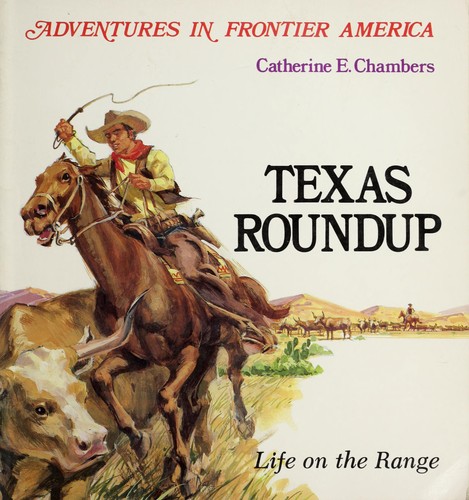
Texas roundup
Catherine E. Chambers
In nineteenth-century Texas, a young boy learns a great deal about life on the range when he is at last allowed to accompany the ranch hands on the spring roundup.

by Frederick Nolan (1992)
The legend of the Lincoln County War in New Mexico and its most romantic figure, Billy the Kid, holds a special place in the history of the American West. Fueled by greed, propelled by religious and racial prejudice, inflamed by liquor and firearms, the war was a struggle to the death for the economic domination of a region where both sides saw enormous opportunity for acquiring wealth. In the end, neither side won and both suffered tremendous losses, human and financial. John Tunstall, the McSweens, Jimmy Dolan, Billy the Kid, the Hispanic townspeople of Lincoln, the outsiders who tried to understand what was happening and restore law and order to the strife-torn territory--all speak out, and Frederick Nolan weaves their stories and opinions together with his own insightful commentary to produce a seamless, immensely readable account enlivened with eighty-three photographs and three maps. Selected by True West magazine as one of its Fifty Greatest Western Books of the 20th Century, acknowledged to be the fullest and most carefully researched study of perhaps the most famous feud in the history of the American West, Frederick Nolan's masterwork, The Lincoln County War, A Documentary History, the result of fifty years of research, is now presented in a new edition which includes an addendum with corrections and additions, together with a new foreword by the author.
Catherine E. Chambers
In nineteenth-century Texas, a young boy learns a great deal about life on the range when he is at last allowed to accompany the ranch hands on the spring roundup.

Donald P. McNeilly
"In this study, Donald P. McNeilly examines how moderately wealthy planters and sons of planters immigrated into the virtually empty lands of Arkansas seeking their fortune and to establish themselves as the leaders of a new planter aristocracy west of the Mississippi River. These men, sometimes alone, sometimes with family, and usually with slaves, sought the best land possible, cleared it, planted their crops, and erected crude houses and other buildings. Life was difficult for these would-be leaders of society and their families, and especially for the slaves who toiled to create fields in which they labored to produce a crop.". "McNeilly argues that by the time of Arkansas's statehood in 1836, planters and large farmers had secured a hold over their frontier home and that between 1840 and the Civil War, planters solidified their hold on politics, the economy, and society in Arkansas. The author takes a topical approach to the subject, with chapters on migration, slavery, non-planter whites, politics, and the secession crisis of 1860-61. McNeilly offers a first-rate analysis of the creation of a white, cotton-based society in Arkansas, shedding light not only on the southern frontier, but also on the established Old South before the Civil War."--BOOK JACKET.

Rebecca Stefoff
Describes what life was like for those children who were uprooted from their midwestern homes and transported by their families across the frontier in wagons and on horseback.

Stephen Bly
The Joyton family, who run the Sonora Pass stagecoach station, deal with the mysterious shooting death of a passenger and welcome new neighbors who open a mercantile next door.