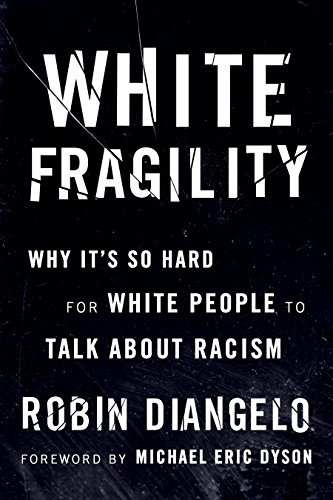
Cover of White Fragility: Why It's So Hard for White People to Talk About Racism
Read Time: ~3.2 hr

White Fragility: Why It's So Hard for White People to Talk About Racism

by Robin DiAngelo (2018)

About this book

White people in North America live in a social environment that protects and insulates them from race-based stress. This insulated environment of racial protection builds white expectations for racial comfort while at the same time lowering the ability to tolerate racial stress. Although white racial insulation is somewhat mediated by social class (with poor and working class urban whites being generally less racially insulated than suburban or rural whites), the larger social environment insulates and protects whites as a group through institutions, cultural representations, media, school textbooks, movies, advertising, and dominant discourses. Racial stress results from an interruption to what is racially familiar. In turn, whites are often at a loss for how to respond in constructive ways., as we have not had to build the cognitive or affective skills or develop the stamina that that would allow for constructive engagement across racial divides. leading to what I refer to as White Fragility. White Fragility is a state in which even a minimum amount of racial stress becomes intolerable, triggering a range of defensive moves. These moves include the outward display of emotions such as anger, fear, and guilt, and behaviors such as argumentation, silence, and leaving the stress-inducing situation. These behaviors, in turn, function to reinstate white racial equilibrium. This book explicates the dynamics of White Fragility and how we might build our capacity in the on-going work towards racial justice. ([source][1]) [1]:

Setting / LocationUnited States / Global
Story EraContemporary
Protagonist / CoreNotable Figure / Community

Readers who enjoyed this also loved

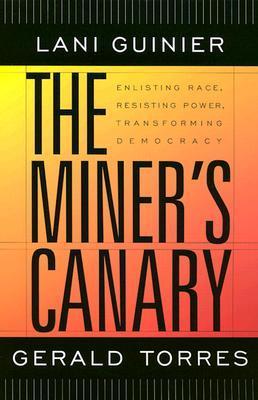
Cover of The Miner’s Canary: Enlisting Race, Resisting Power, Transforming Democracy

The Miner’s Canary: Enlisting Race, Resisting Power, Transforming Democracy

GUINIER

"Like the canary's distress, which alerted miners to poison in the air, issues of race point to conditions in American society that endanger us all. In this pioneering new book, Lani Guinier and Gerald Torres warn us that we ignore race at our peril, and propose a dramatic, hopeful shift in the way we think about race and put it to political use.". "Ignoring racial differences - color blindness - has failed, they argue. Race and power intertwine at every level of social interaction, from classrooms to courtrooms to congressional districts. Only cross-racial coalitions can expose these embedded hierarchies of privilege and - through innovative power-sharing and democratic engagement - demolish them. The authors call this concept of enlisting race to resist power political race.". "The Miner's Canary tells many illuminating stories of political race in action - among black workers in a North Carolina pork plant, among Hispanic organizers in a Chicago mayoral race, among privileged private school students in Boston, among a coalition of education reformers in Texas. Seamlessly weaving narrative with theory, Guinier and Torres reveal the implications of political race for affirmative action, racial profiling, the war on drugs, livable wages, the education budget, voting reform, and many other current debates.". "The aim of political race is not just to remedy racial injustices. It is to empower people of all races to struggle together at the grassroots level, to improve the life chances of everyone who has been "raced" black, regardless of skin color. In a book that is ultimately both aspirational and inspirational, Guinier and Torres envision a recommitment to social justice that promises not only to revitalize the civil rights movement in America but to transform democracy."--BOOK JACKET.

White Fragility: Why It's So Hard for White People to Talk About Racism by Robin DiAngelo | Synopsis, Reviews & Preview | Literally Just Books