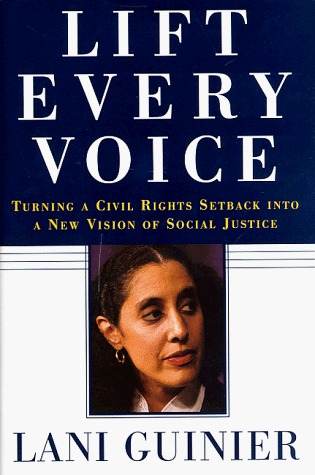

Cover of Lift Every Voice: Turning a Civil Rights Setback Into a New Vision of Social Justice
Read Time: ~5.6 hr

Lift Every Voice: Turning a Civil Rights Setback Into a New Vision of Social Justice

by Lani Guinier (1998)

About this book

In 1993, shortly after his inauguration, new President Bill Clinton nominated his old friend and classmate Lani Guinier to the prestigious and crucial post of Assistant Attorney General for Civil Rights. In the face of concerted opposition - what one friend of Guinier's called "a low-tech lynching" - Clinton backed down, not only withdrawing her nomination, but having refused throughout to give her an opportunity to speak out in her own defense (and his). The result was a civil rights setback of monumental proportions. Now, in this book, at once a memoir and insider's account of what really happened behind the closed doors of the Oval Office, the Justice Department, and the U.S. Senate, and an insightful look at the past, present, and future of civil rights in America, Lani Guinier at last breaks her silence. Unsparing of her own mistakes and shrewdly perceptive about the overt and hidden agendas of those who opposed her, Professor Guinier shows how the president promptly abandoned his ambitious agenda for civil rights at the first hint of criticism from the media and Congress - and how the civil rights movement suffered a major setback as a result. Above all, Guinier goes on to describe how her experience at the hands of the press, the White House, and her congressional enemies has given her both a new voice and a renewed faith in the ongoing struggle for civil rights. Using her own nomination as a symbolic point of reference, she shows just how weak and divided the cause of civil rights has become, as its leaders have all too often been silenced by the very people they should be challenging.

Setting / LocationUnited States / Global
Story EraLate 20th Century
Protagonist / CoreNotable Figure / Community

Readers who enjoyed this also loved

Cover of Assata: An Autobiography

Assata: An Autobiography

Assata Shakur

On May 2, 1973, Black Panther Assata Shakur (previously known as JoAnne Chesimard) lay in a hospital, close to death, handcuffed to her bed, while local, state, and federal police attempted to question her about the shootout on the New Jersey Turnpike that had claimed the life of a white state trooper. Long a target of J. Edgar Hoover's campaign to defame, infiltrate, and criminalize Black nationalist organizations and their leaders, Shakur was incarcerated for four years prior to her conviction on flimsy evidence in 1977 as an accomplice to murder. This intensely personal and political autobiography belies the fearsome image of JoAnne Chesimard long projected by the media and the state. With wit and candor, Assata Shakur recounts the experiences that led her to a life of activism and portrays the strengths, weaknesses, and eventual demise of Black and White revolutionary groups at the hand of government officials. The result is a signal contribution to the literature about growing up Black in America that has already taken its place alongside The Autobiography of Malcolm X and the works of Maya Angelou. Two years after her conviction, Assata Shakur escaped from prison. She was given political asylum by Cuba, where she now resides.

Lift Every Voice: Turning a Civil Rights Setback Into a New Vision of Social Justice by Lani Guinier | Synopsis, Reviews & Preview | Literally Just Books